Volume 22, Issue 1 (1-2026)
Abstract
(4858 Views) |
Full-Text (PDF)
(1480 Downloads)
|
Graphical Abstract
|
Reseach Highlights
Graphical Abstract:
Reseach Highlights:
Highlights
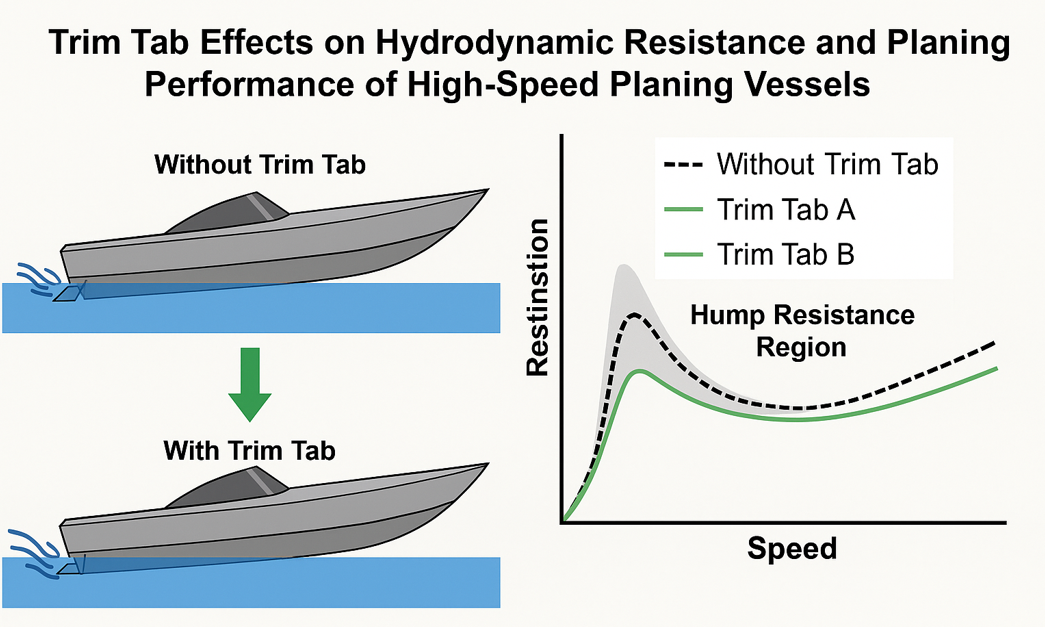
- Experimental towing tank tests were conducted on two 40-foot scaled beam-type planning vessel models equipped with adjustable trim tabs.
- Results show that optimal trim tab deployment significantly reduces hydrodynamic resistance and lowers the hump resistance region.
- Trim Tab configuration “B” enabled earlier planning transition, reduced bow impact, and lowered power demand compared to untrimmed and Tab A cases.
- Scaling effects, model construction tolerances, and ITTC-recommended procedures were carefully addressed to ensure fidelity with full-scale performance.
- Findings provide practical insights into improving propulsion efficiency, vessel stability, and structural safety in high-speed marine craft design.
|
Audio file of the article abstract [MP3] (180 Download)
Abstract
(4273 Views) |
Full-Text (PDF)
(1460 Downloads)
|
Graphical Abstract
|
Reseach Highlights
Graphical Abstract:
Reseach Highlights:
Highlights
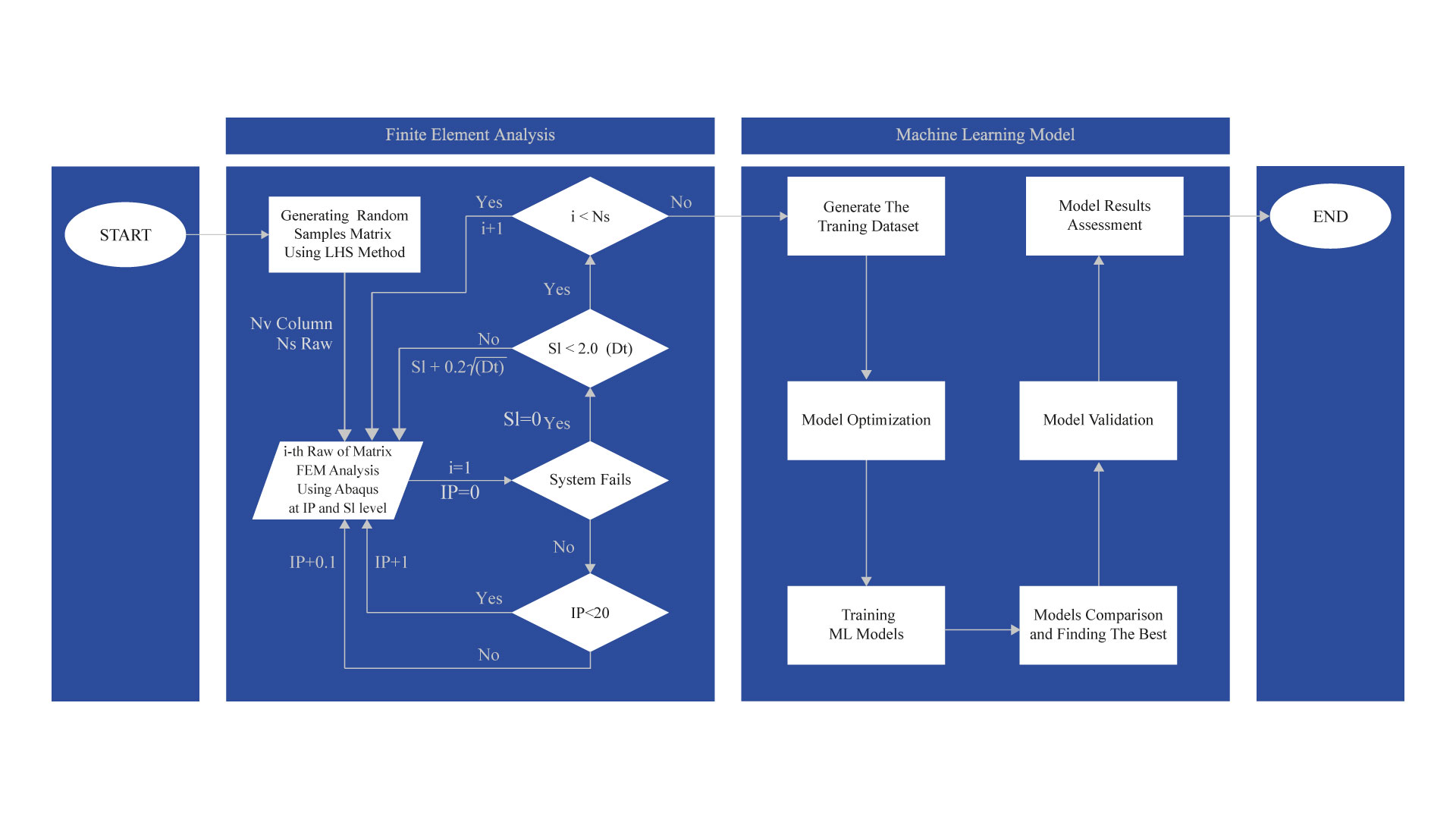
- Developed LHS-FEM database to predict MVMS in corroded pipelines using ML.
- Integrated ABAQUS with Python to automate nonlinear FE analysss for pipeline defects.
- Evaluated five ML models with grid search and k-fold to optimize prediction accuracy.
- NN and DTR models performed well in predicting MVMS; NN showed robust generalization.
- Used learning curve analysis and PI method to validate models and assess parameters.
|
Audio file of the article abstract [M4A] (161 Download)
Abstract
(2818 Views) |
Full-Text (PDF)
(1222 Downloads)
|
Graphical Abstract
|
Reseach Highlights
Graphical Abstract:

Reseach Highlights:
Highlights
1- Comprehensive island-scale water-budget shows that population growth not rainfall variabilityis the primary driver of scarcity on Qeshm.
2- Trend scenarios project a sustained decline in per-capita renewable water, pushing the island toward severe stress within two decades without intervention.
3- A ≤40% extraction cap on renewable flows enables viable mixed allocations (municipal–agriculture–industry) while remaining within sustainable limits.
4- Long-term monitoring documents simultaneous groundwater-level decline and rising EC, evidencing coupled quantity–quality stress and heightened seawater-intrusion risk.
5- A practical management toolbox demand restraint and loss control, managed aquifer recharge, fit-for-purpose reuse, and desalination as a quantitative backstop with transparent energy/brine accountingsupports resilient, cost-effective island water security.
|
Audio file of the article abstract [MP3] (144 Download)
Abstract
(2294 Views) |
Full-Text (PDF)
(785 Downloads)
|
Graphical Abstract
|
Reseach Highlights
Graphical Abstract:

Reseach Highlights:
Highlights
- An APSO-tuned PID controller is developed for optimal heading control of a linearized high-speed container ship model.
- Adaptive PSO improves the tuning precision by balancing global exploration and local exploitation.
- The APSO-PID reduces overshoot from 35.1% to 17.6% and shortens settling time while maintaining a 31.9 dB gain margin.
- Control effort is minimized through optimization, enhancing efficiency and actuator longevity.
- APSO-PID clearly outperforms classical PID and standard PSO in robustness, tracking accuracy, and convergence speed.
|
Audio file of the article abstract [MP3] (121 Download)
Abstract
(4434 Views) |
Full-Text (PDF)
(1940 Downloads)
|
Graphical Abstract
|
Reseach Highlights
Graphical Abstract:

Reseach Highlights:
Highlights:
- A novel vertical double‑flap WEC is introduced for wave energy harvesting
- Coupled dynamic equations of the double‑flap WEC are derived using Lagrangian mechanics
- Wave‑induced hydrodynamic coefficients of the upper and lower flaps are comparatively analyzed
- The dynamic response and power production of the vertical double‑flap WEC are investigated
- The upper flap is shown to generate higher power due to its larger rotational motion
|
Audio file of the article abstract [MP3] (201 Download)
Abstract
(1632 Views) |
Full-Text (PDF)
(647 Downloads)
|
Graphical Abstract
|
Reseach Highlights
Graphical Abstract:
Reseach Highlights:
Highlights
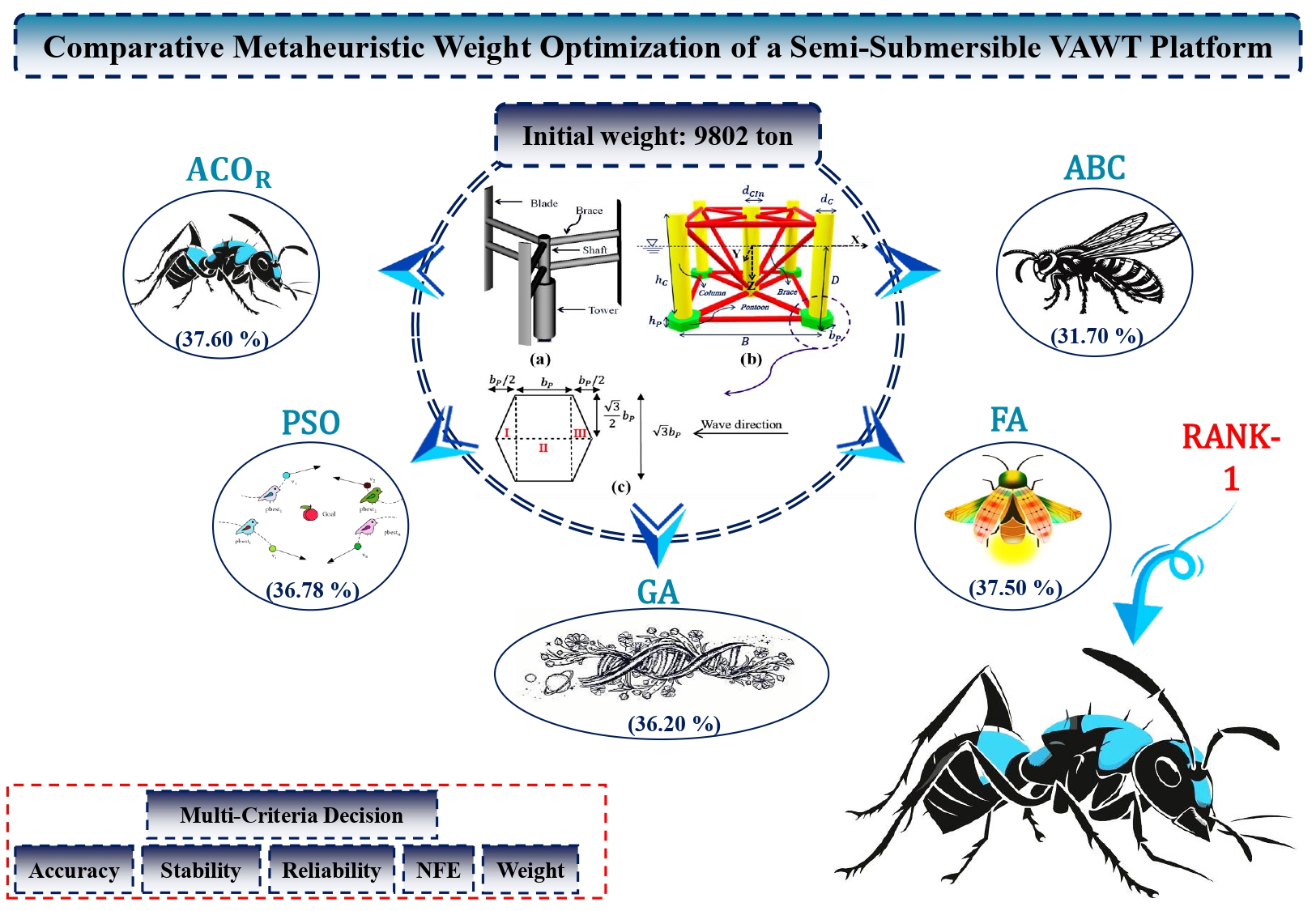
-This study compares GA, ACOR, ABC, FA, and PSO algorithms for weight optimization of a semi-submersible substructure of VAWT with hydrostatic stability, heave natural period, airgap, and geometric feasibility constraints.
-ANOVA & Tukey's test were performed and based on TOPSIS, ACOR was ranked first with weight reduction of 37.6% and superior accuracy and stability.
|
Audio file of the article abstract [MP3] (109 Download)
Export as:
HTML
|
XML
|
RSS

 Experimental and Theoretical Investigation of Trim Tab Effects on Hydrodynamic Resistance and Planning Performance of High-Speed Planning Vessels