Write your message


XML Print


1- Department of Civil Engineering, SRBIAU
2- Department of Physics Oceanography, SRBIAU
3- Department of Mechanical Engineering, SRBIAU
Abstract:   (37 Views)
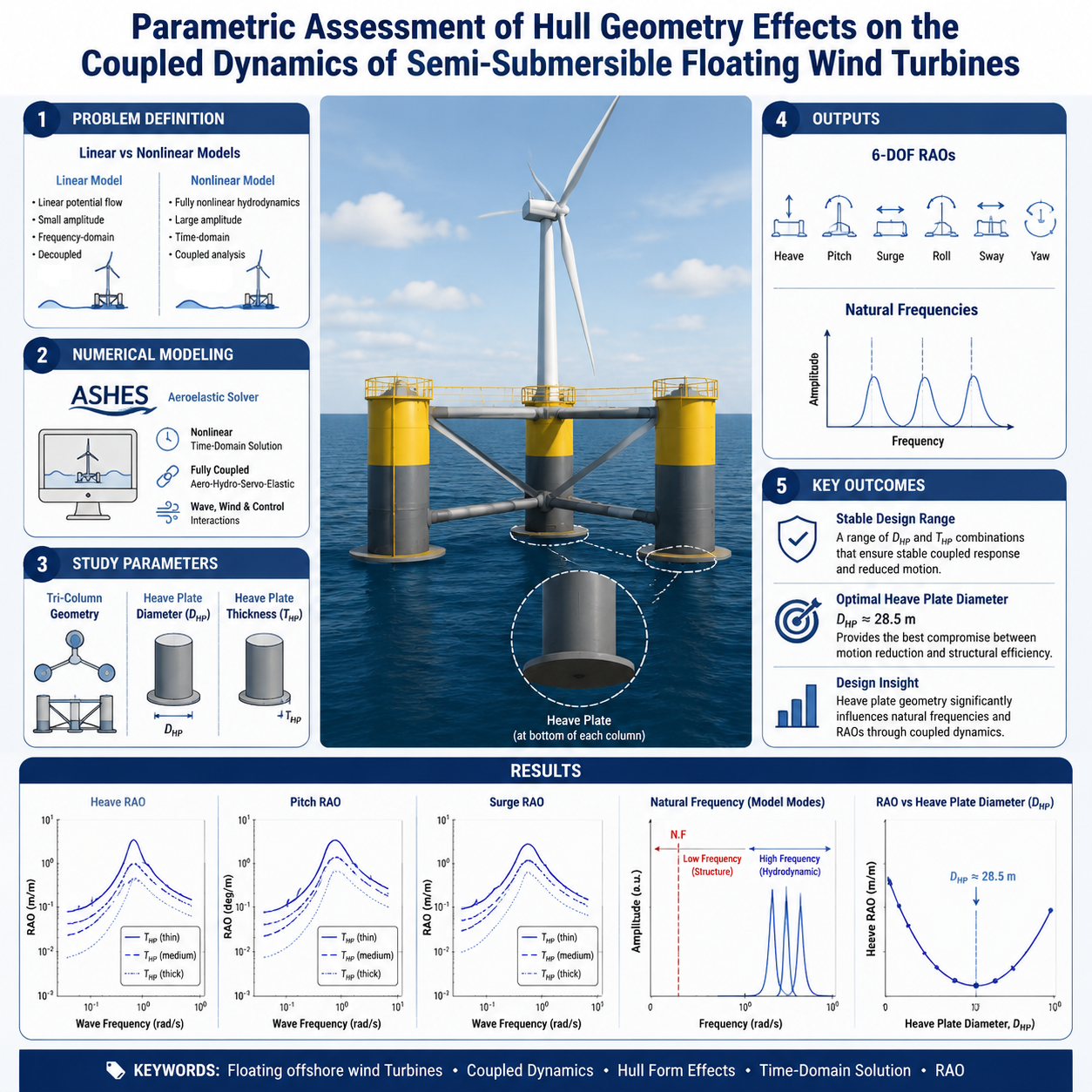
This study presents a systematic investigation into the influence of geometric parameters and structural characteristics on the dynamic response of a semi-submersible platform supporting a floating wind turbine, with an emphasis on identifying stable performance regimes rather than determining a single optimal configuration. The analyses initiated with preliminary linear evaluations and were subsequently complemented by nonlinear time-domain simulations. A comparison of these approaches demonstrates that while the linear model is useful for identifying general response trends, it fails to fully capture oscillation amplitudes or the coupling intensity among degrees of freedom, particularly under hydrodynamic nonlinearities and mooring system effects. Consequently, a realistic assessment of system behavior necessitates nonlinear analysis. The investigation focused primarily on surge, heave, and pitch motions, as sway, roll, and yaw contributed minimally to the global response. Results indicate that the vertical and rotational motions of the platform are governed not only by the heave plate geometry but also by its interaction with the offset column arrangement. Variations in heave plate diameter and thickness, in conjunction with the geometric configuration of the offset columns, alter the dynamic response by modifying the added mass, hydrodynamic damping, and the relative positions of the centers of gravity and buoyancy. Within the examined range, heave plate diameters of 24–30 m and thicknesses equivalent to 7–10.5% of the offset column height produced more stable responses without shifting natural frequencies toward resonance. Specifically, a diameter of approximately 28.5 m and a thickness of around 8% yielded balanced surge, heave, and pitch responses. However, comparable performance across adjacent configurations suggests a robust design envelope rather than a single unique optimum. Overall, the findings highlight the utility of evaluating geometric parameters within an integrated framework to elucidate the relationships between platform geometry, hydrodynamic coefficients, and the coupled dynamic response.
Full-Text [PDF 1487 kb]   (13 Downloads)    

Highlights
  1. A systematic parametric numerical study was conducted to examine the coupled dynamics of a semi-submersible floating wind turbine platform.
  2. A two-stage workflow combining linear screening and nonlinear time-domain simulations was employed to provide a more realistic response assessment.
  3. Surge, heave, and pitch were identified as the dominant motions, while sway, roll, and yaw remained negligible in the investigated cases.
  4. Platform performance was governed by interacting design variables, including heave-plate geometry, offset-column configuration, mass distribution, and mooring characteristics.
  5. The results indicate a favorable and stable design range, supporting a robust design envelope rather than a single unique optimum.

 
Type of Study: Research Paper | Subject: Offshore Hydrodynamic
Received: 2026/02/5 | Accepted: 2026/06/8

References
1. Withee, J. E., (2004). Fully coupled dynamic analysis of a floating wind turbine system (Doctoral dissertation, Monterey California. Naval Postgraduate School).
2. Yang, Y., Bashir, M., Michailides, C., Li, C., & Wang, J., (2020). Development and application of an aero-hydro-servo-elastic coupling framework for analysis of floating offshore wind turbines. Renewable Energy, 161, 606-625. http://dx.doi.org/10.1016/j.renene.2020.07.134. [DOI:10.1016/j.renene.2020.07.134]
3. Wayman, E. N. (2006). Coupled Dynamic Modeling of Floating Wind Turbine Systems. Massachusetts Institute of Technology and National Renewable Energy Laboratory. https://doi.org/10.4043/18287-MS [DOI:10.4043/18287-MS.]
4. Maali Amiri, M., Shadman, M., & Estefen, S. F., (2024). A Review of Numerical and Physical Methods for Analyzing the Coupled Hydro-Aero-Structural Dynamics of Floating Wind Turbine Systems. Journal of Marine Science and Engineering, 12(3), 392. https://doi.org/10.3390/jmse12030392 [DOI:10.3390/jmse12030392.]
5. Matha, D., Schlipf, M., Pereira, R., & Jonkman, J., (2011), June. Challenges in simulation of aerodynamics, hydrodynamics, and mooring-line dynamics of floating offshore wind turbines. In ISOPE International Ocean and Polar Engineering Conference (pp. ISOPE-I). ISOPE. https://onepetro.org/ISOPEIOPEC/proceedings-abstract/ISOPE11/All-ISOPE11/12370.
6. Li, H., & Bachynski-Polić, E. E., (2021). Validation and application of nonlinear hydrodynamics from CFD in an engineering model of a semi-submersible floating wind turbine. Marine Structures, 79, 103054. https://doi.org/10.1016/j.marstruc.2021.103054 [DOI:10.1016/j.marstruc.2021.103054.]
7. Kreuzer, E. ed., (2008). IUTAM Symposium on Fluid-Structure Interaction in Ocean Engineering: Proceedings of the IUTAM Symposium Held in Hamburg, Germany, July 23-26, 2007 (Vol. 8). Springer Science & Business Media. [DOI:10.1007/978-1-4020-8630-4]
8. Armudi, A., Marques, W. C., & Oleinik, P. H., (2017). Numerical analysis of ship motion under linear and nonlinear waves. Scientia Plena, 13(4). [DOI:10.14808/sci.plena.2017.049901]
9. He, Y. P., Zhao, Y. S., Yang, X. Y., & Zhang, G. R., (2024). Coupled dynamic response analysis of multi-column floating offshore wind turbine with low center of gravity. Journal of Ocean Engineering and Science. http://dx.doi.org/10.1016/j.joes.2022.07.004. [DOI:10.1016/j.joes.2022.07.004]
10. Zheng, Z., Chen, J., Liang, H., Zhao, Y., & Shao, Y., (2020). Hydrodynamic responses of a 6 MW spar-type floating offshore wind turbine in regular waves and uniform current. Fluids, 5(4), 187. https://doi.org/10.3390/fluids5040187 [DOI:10.3390/fluids5040187.]
11. Xu, K., Gao, Z., & Moan, T., (2019). A study on fully nonlinear wave load effects on floating wind turbine. Journal of Fluids and Structures, 88, 216-240. https://doi.org/10.1016/j.jfluidstructs.2019.05.008 [DOI:10.1016/j.jfluidstructs.2019.05.008.]
12. Tan, L., Ikoma, T., Aida, Y., & Masuda, K., (2021). Mean wave drift forces on a barge-type floating wind turbine platform with moonpools. Journal of Marine Science and Engineering, 9(7), 709. https://doi.org/10.3390/jmse9070709 [DOI:10.3390/jmse9070709.]
13. Sandua-Fernández, I., Vittori, F., Eguinoa, I., & Cheng, P. W., (2022), November. Impact of hydrodynamic drag coefficient uncertainty on 15 MW floating offshore wind turbine power and speed control. In Journal of Physics: Conference Series (Vol. 2362, No. 1, p. 012037). IOP Publishing. http://dx.doi.org/10.1088/1742-6596/2362/1/012037. [DOI:10.1088/1742-6596/2362/1/012037]
14. Li, H., & Bachynski-Polić, E. E., (2021). Validation and application of nonlinear hydrodynamics from CFD in an engineering model of a semi-submersible floating wind turbine. Marine Structures, 79, 103054. https://doi.org/10.1016/j.marstruc.2021.103054 [DOI:10.1016/j.marstruc.2021.103054.]
15. Michael, J. G., & Kendon, T. E. (2008). Viscous Damping of Large Floating Structures. In IUTAM Symposium on Fluid-Structure Interaction in Ocean Engineering (pp. 69-78). Dordrecht: Springer Netherlands. [DOI:10.1007/978-1-4020-8630-4_7]
16. Ferri, G., Marino, E., & Borri, C., (2020). Optimal dimensions of a semisubmersible floating platform for a 10 MW wind turbine. Energies, 13(12), 3092. https://doi.org/10.3390/en13123092 [DOI:10.3390/en13123092.]
17. International Electrotechnical Commission, (2019). Wind energy generation systems -Part 3-1: Design requirements for fixed offshore wind turbines. International standard IEC, pp.61400-3. https://webstore.iec.ch/publication/29360.
18. Morison, J. R., Johnson, J. W., & Schaaf, S. A., (1950). The force exerted by surface waves on piles. Journal of Petroleum Technology, 2(05), 149-154. https://doi.org/10.2118/950149-G [DOI:10.2118/950149-G.]
19. MacCamy, R. C., & Fuchs, R. A., (1954). Wave forces on piles: a diffraction theory (No. 69). US Beach Erosion Board. https://usace.contentdm.oclc.org/digital/collection/p266001coll1/id/7401/
20. Hansen, M., (2008). Aerodynamics of wind turbines. Routledge.
21. Hansen, M. H., Gaunaa, M., & Madsen, H. A., (2004). A Beddoes-Leishman type dynamic stall model in state-space and indicial formulations.
22. Journée, J. M. J., & Massie, W. W., (2001). Offshore Hydromechanics. Delft. Delft University of Technology.
23. Javidaneh, A., (2023). Director General of National Cartographic Center of Iran (NCC).Retrieved from ncc.gov: https://en.ncc.gov.ir/Services.
24. Jonkman, J., & Musial, W., 2010. Offshore code comparison collaboration (OC3) for IEA Wind Task 23 offshore wind technology and deployment (No. NREL/TP-5000-48191). National Renewable Energy Lab.(NREL), Golden, CO (United States). https://www.researchgate.net/publication/238058967_Offshore_Code_Comparison_Collaboration_OC3_for_IEA_Wind_Task_23_Offshore_Wind_Technology_and_Deployment
25. Oceans, g. b., (2023). Gridded Bathymetry Data-Data & Products - Seabed Retrieved from GEBCO: https://www.gebco.net
26. Newman, J. N. (2004, June). Progress in wave load computations on offshore structures. In 23rd OMAE Conference, Vancouver, Canada.‌
27. Robertson, A., (2014). Definition of the semisubmersible floating system for phase II of OC4. NREL Technical Report, NREL/TP-5000-60601. [DOI:10.2172/1155123] [PMID]
28. Chakrabarti, S. K., (1994). Offshore structure modeling (Vol. 9). world scientific. [DOI:10.1142/2127]

Send email to the article author


Rights and permissions
Creative Commons License This work is licensed under a Creative Commons Attribution-NonCommercial 4.0 International License.

Creative Commons License
International Journal of Maritime Technology is licensed under a

Creative Commons Attribution-NonCommercial 4.0 International License.