Enter your email address
Submit




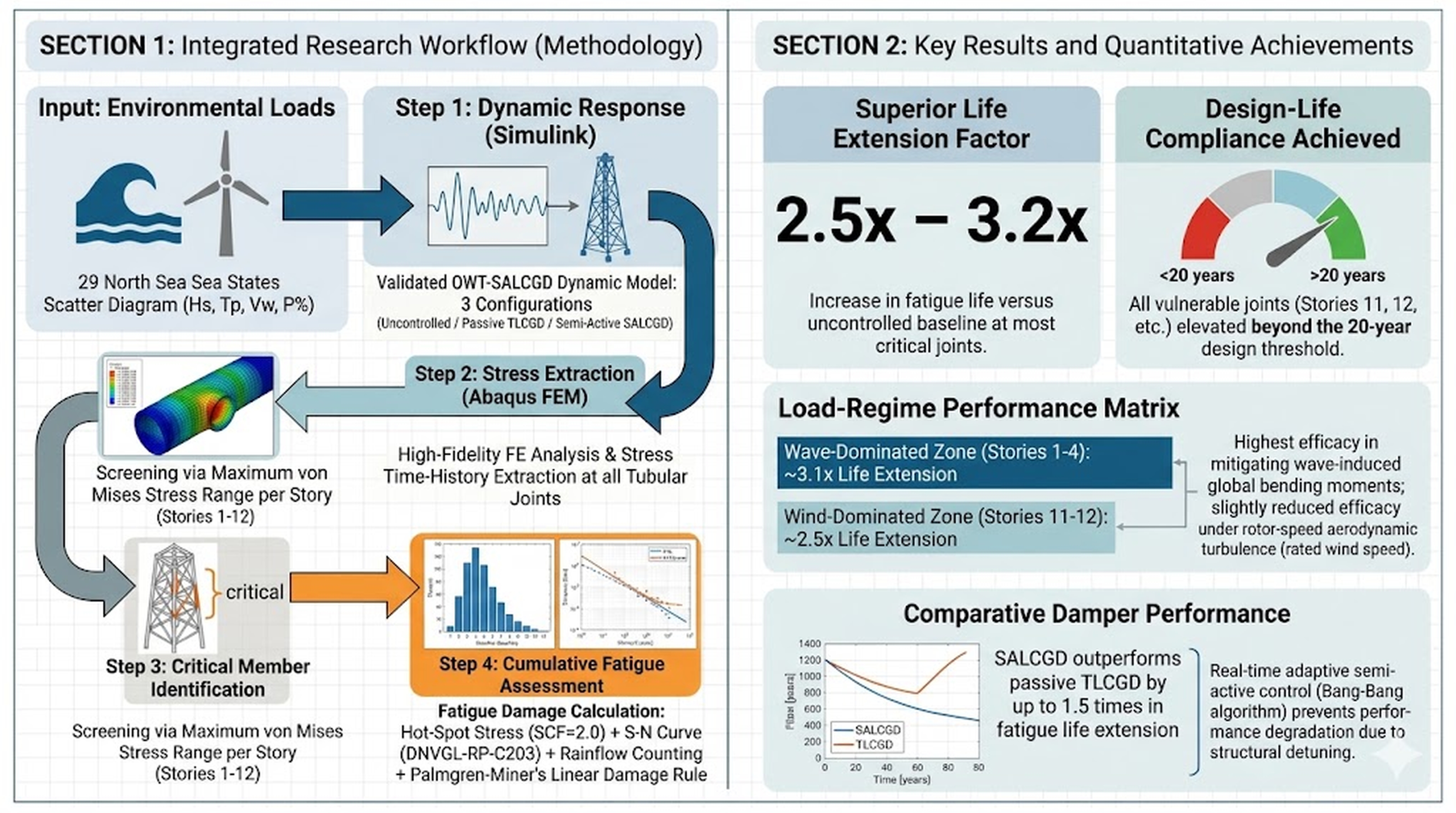
| Fatigue damage is the predominant failure mechanism for offshore wind turbine support structures, with tubular joints of jacket foundations being particularly vulnerable due to stress concentrations under myriad cyclic loadings. This paper presents a rigorous and detailed methodology for assessing and enhancing the fatigue life of a 5 MW jacket-supported offshore wind turbine (JOWT) through the implementation of an advanced vibration control system. A Semi-Active Liquid Column Gas Damper (SALCGD) is employed to mitigate dynamic responses, thereby reducing stress ranges at critical hotspots. The study employs a multi-step, integrated numerical framework: a high-fidelity finite element model of the JOWT is developed; dynamic analyses are conducted under 29 distinct North Sea wave and wind conditions for three structural configurations—uncontrolled, with a passive damper (TLCGD), and with the semi-active damper (SALCGD); stress time histories at all tubular joints are extracted; critical members are identified based on stress severity; and finally, cumulative fatigue damage is calculated using the Rainflow counting method, relevant S-N curves for welded details, and Palmgren-Miner's rule. The results demonstrate a transformative improvement in fatigue performance. The SALCGD dramatically reduces stress ranges at the hotspots, leading to a remarkable increase in the fatigue life of the most critical structural joints by a factor of 2.5 to 3.2 compared to the uncontrolled case. Furthermore, it outperforms the passive TLCGD, providing up to 1.5 times greater life extension. The analysis reveals that in the uncontrolled scenario, several critical joints, particularly in the wave-dominant lower stories and wind-dominant upper stories, possess a fatigue life shorter than the 20-year design life. The SALCGD successfully elevates the life of all these joints well beyond this critical threshold. This study quantitatively establishes that semi-active vibration control is not merely a serviceability tool but a powerful and essential strategy for significantly extending the operational lifespan, ensuring structural integrity, and improving the economic sustainability of offshore wind infrastructure. |
| Rights and permissions | |
 |
This work is licensed under a Creative Commons Attribution-NonCommercial 4.0 International License. |


International Journal of Maritime Technology is licensed under a
Creative Commons Attribution-NonCommercial 4.0 International License.