Enter your email address
Submit

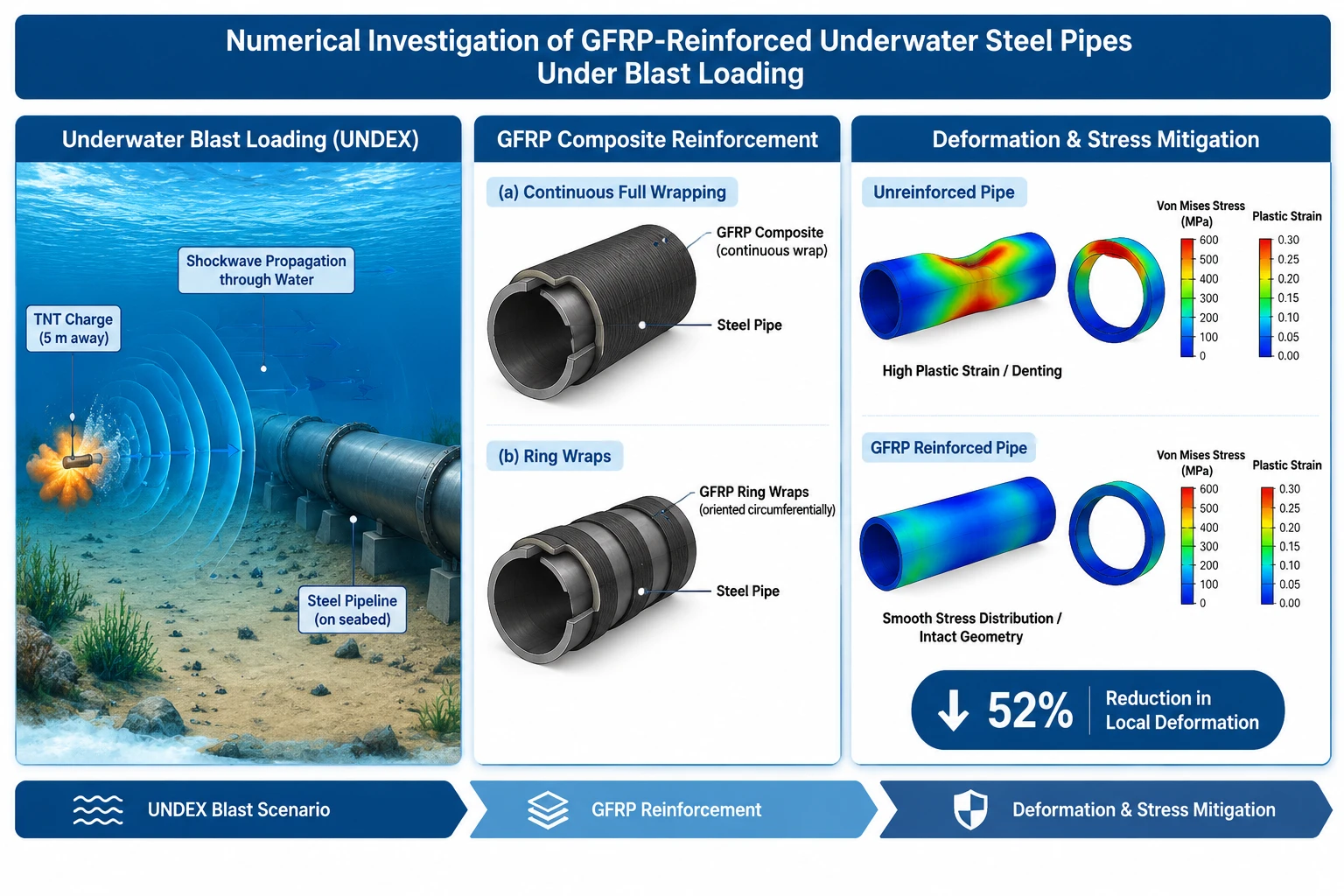
| The analysis of the behavior of submerged steel pipes subjected to underwater explosions is of great importance, as these pipes are used in many offshore foundations, piers, and marine structures. In this study, the behavior of submerged steel pipes under underwater explosions is investigated using numerical modeling in ABAQUS software. First, the validity of the model was verified by comparing the results with a reference paper. Then, by simulating three explosive scenarios with different TNT masses at a distance of 5 meters from the pipe, the results showed that with increasing TNT mass, the kinetic energy and strain of the pipe increase. Furthermore, four different pipe strengthening methods using GFRP sheets were investigated. The results showed that continuous use of GFRP is the most effective method for reducing stress, deformation and pipe damage under underwater explosions. This method can reduce local pipe deformation by up to 52%. Additionally, the use of closely spaced GFRP rings can also be effective in reducing pipe stress and deformation to some extent. The findings of this study showed that underwater explosions cause less damage to the pipe than explosions in air due to the damping of blast waves in water. This study also assists designers and engineers in the design and strengthening of submerged pipes in underwater environments. However, experimental tests are recommended for more accurate research and to investigate the effects of other factors such as type of bed soil and water temperature |
| Rights and permissions | |
 |
This work is licensed under a Creative Commons Attribution-NonCommercial 4.0 International License. |


International Journal of Maritime Technology is licensed under a
Creative Commons Attribution-NonCommercial 4.0 International License.