[Articles In Press]
Abstract
(1906 Views) |
Full-Text (PDF)
(567 Downloads)
|
Graphical Abstract
|
Reseach Highlights
Graphical Abstract:
Reseach Highlights:
Highlights
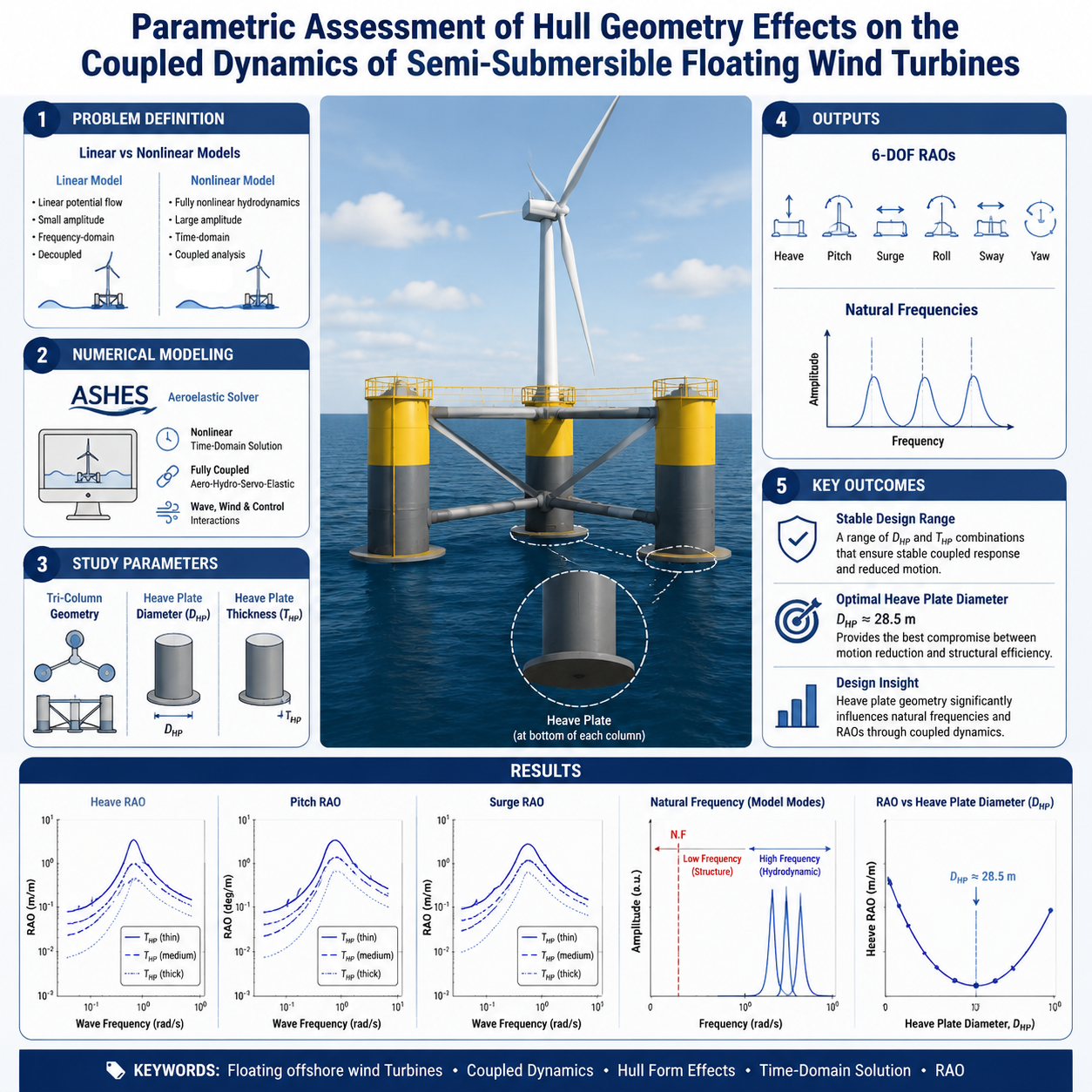
- A systematic parametric numerical study was conducted to examine the coupled dynamics of a semi-submersible floating wind turbine platform.
- A two-stage workflow combining linear screening and nonlinear time-domain simulations was employed to provide a more realistic response assessment.
- Surge, heave, and pitch were identified as the dominant motions, while sway, roll, and yaw remained negligible in the investigated cases.
- Platform performance was governed by interacting design variables, including heave-plate geometry, offset-column configuration, mass distribution, and mooring characteristics.
- The results indicate a favorable and stable design range, supporting a robust design envelope rather than a single unique optimum.
|
Audio file of the article abstract [MP3] (106 Download)
Abstract
(1222 Views) |
Full-Text (PDF)
(352 Downloads)
|
Graphical Abstract
|
Reseach Highlights
Graphical Abstract:
Reseach Highlights:
Highlights
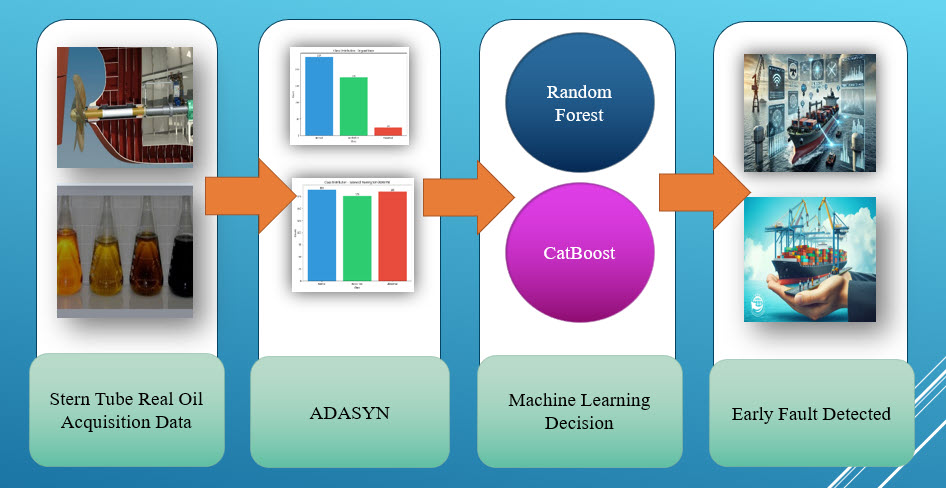
1. Critical Role of Stern Tube Monitoring, ensuring safe and reliable ship operation requires continuous monitoring of the stern tube as a key marine component.
2. AI-Driven Oil Analysis, the study integrates real oil analysis data with advanced AI algorithms, achieving about 85% accuracy.
3. Real-World Validation, the proposed method was successfully validated under actual sea operating conditions.
4. Early Fault Detection, potential failures were identified up to six months before dry docking, enabling timely maintenance and risk reduction.
5. Enhanced Reliability and Sustainability, combining tribology with data-driven analytics improve stern tube reliability and supports sustainable maritime operation.
|
Audio file of the article abstract [MP3] (56 Download)
Abstract
(950 Views) |
Full-Text (PDF)
(271 Downloads)
|
Graphical Abstract
|
Reseach Highlights
Graphical Abstract:

Reseach Highlights:
Highlights
A calibrated MIKE21 model successfully simulated wave, current, and sediment dynamics in Chabahar Bay.
Port development reduced wave energy, modified hydrodynamic circulation, and altered sediment transport pathways, increasing deposition between Shahid Beheshti and Shahid Kalantari Ports while identifying erosion-prone coastal zones.
The results provide a reliable tool for sustainable port development and coastal management.
|
Audio file of the article abstract [MP3] (74 Download)
Abstract
(967 Views) |
Full-Text (PDF)
(227 Downloads)
|
Graphical Abstract
|
Reseach Highlights
Graphical Abstract:
Reseach Highlights:
Highlights
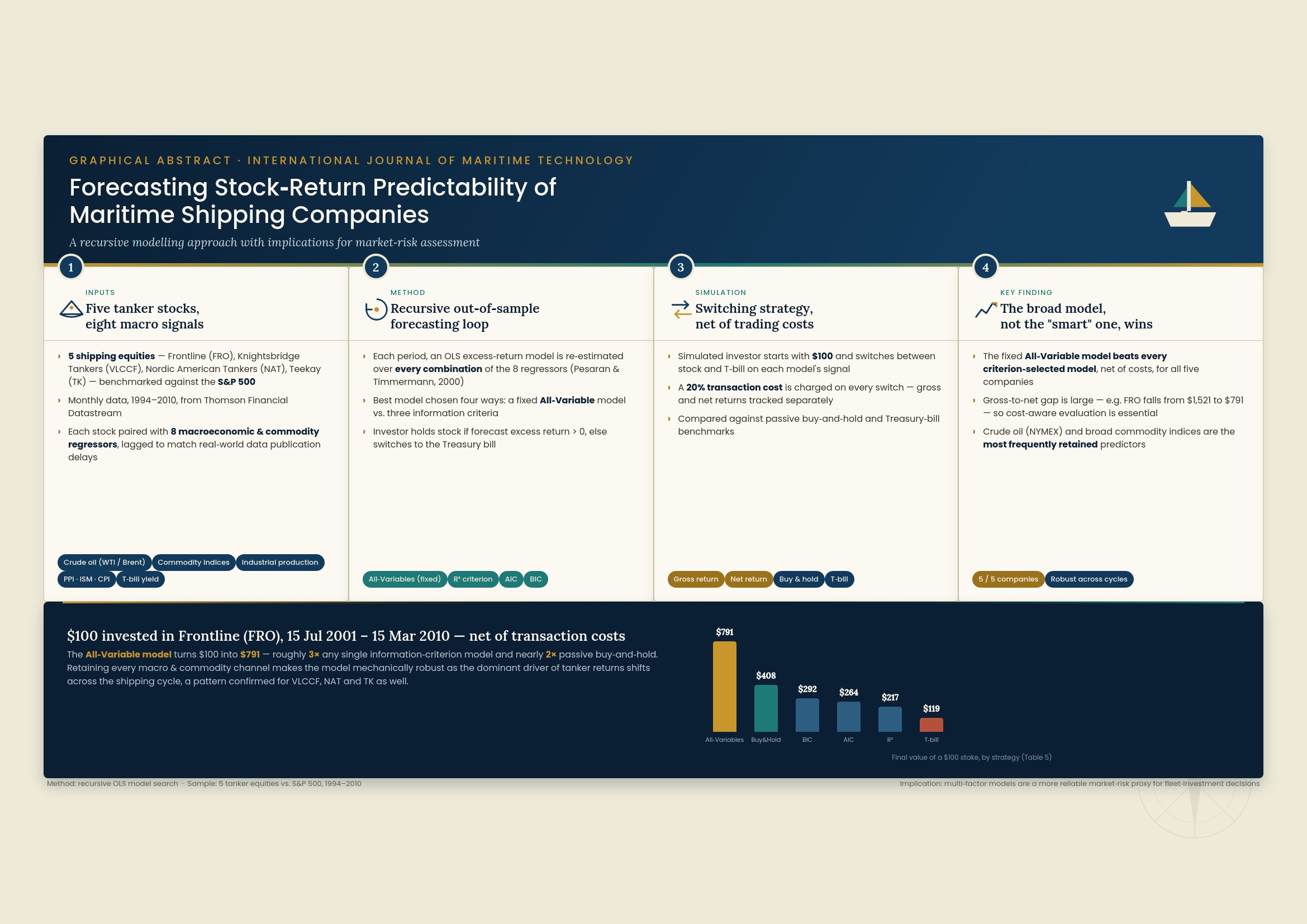
- Applies a recursive out-of-sample forecasting framework to five tanker-shipping stocks vs. the S&P 500.
- Shows the fixed All-Variable model beats all criterion-selected models (R², AIC, BIC), net of costs.
- Reveals a large gross-vs-net return gap once 20% transaction costs are applied to switching strategies.
- Identifies crude oil and broad commodity indices as the most consistently retained predictors.
- Frames shipping-equity predictability as a market-risk proxy for fleet-investment decisions.
|
Audio file of the article abstract [MP3] (65 Download)
Abstract
(882 Views) |
Full-Text (PDF)
(314 Downloads)
|
Graphical Abstract
|
Reseach Highlights
Graphical Abstract:
Reseach Highlights:
Highlights
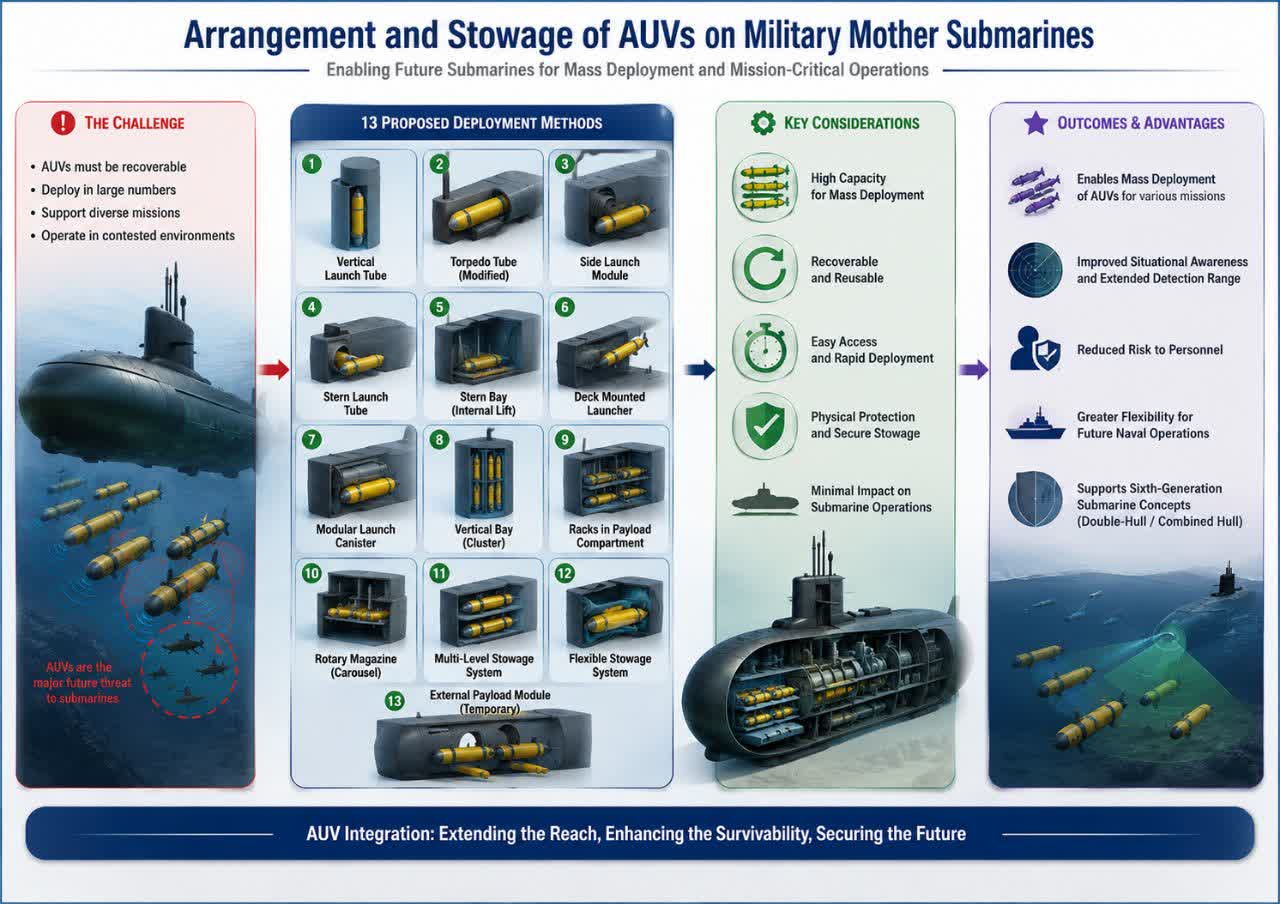
Thirteen AUV deployment architectures are proposed for mother submarines.
Novel concepts improve AUV launch, recovery, and onboard stowage.
Double-hull submarines provide greater flexibility for AUV integration.
Mass deployment of recoverable AUVs enhances future naval operations.
Ocean transparency is reshaping next-generation submarine architecture.
|
Audio file of the article abstract [MP3] (56 Download)
Abstract
(655 Views) |
Full-Text (PDF)
(104 Downloads)
|
Graphical Abstract
|
Reseach Highlights
Graphical Abstract:
Reseach Highlights:
Highlights
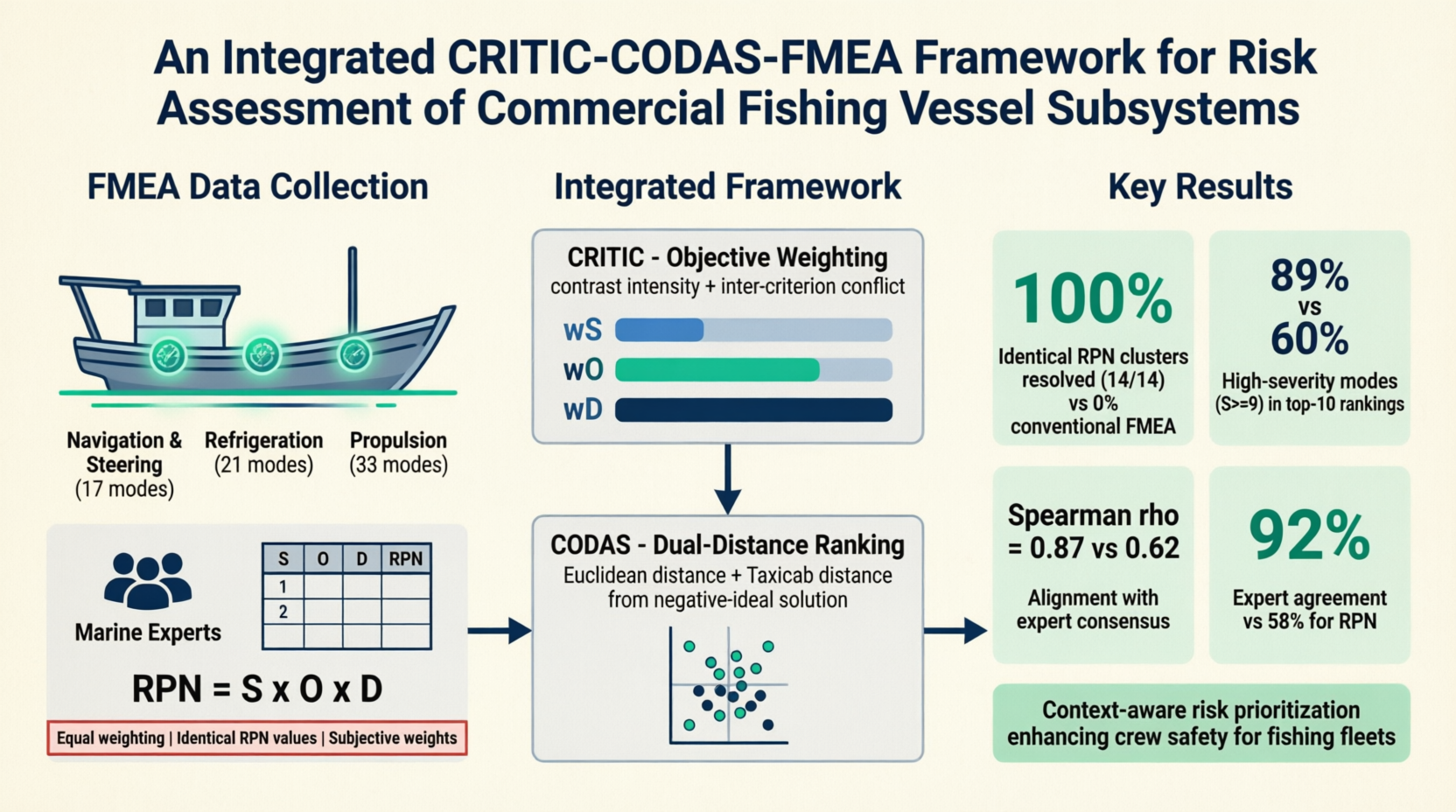
- CRITIC‑CODAS‑FMEA resolves identical RPN clusters across fishing‑vessel failure modes.
- CRITIC derives objective subsystem‑specific weights, eliminating subjective weighting.
- CODAS dual‑distance ranking elevates high‑severity modes into top rankings versus conventional FMEA.
- Rankings align with expert consensus.
- Context‑aware prioritization transforms FMEA into a crew‑safety decision tool for commercial fishing fleets.
|
Audio file of the article abstract [MP3] (41 Download)
Abstract
(660 Views) |
Full-Text (PDF)
(115 Downloads)
|
Graphical Abstract
|
Reseach Highlights
Graphical Abstract:
Reseach Highlights:
Highlights:
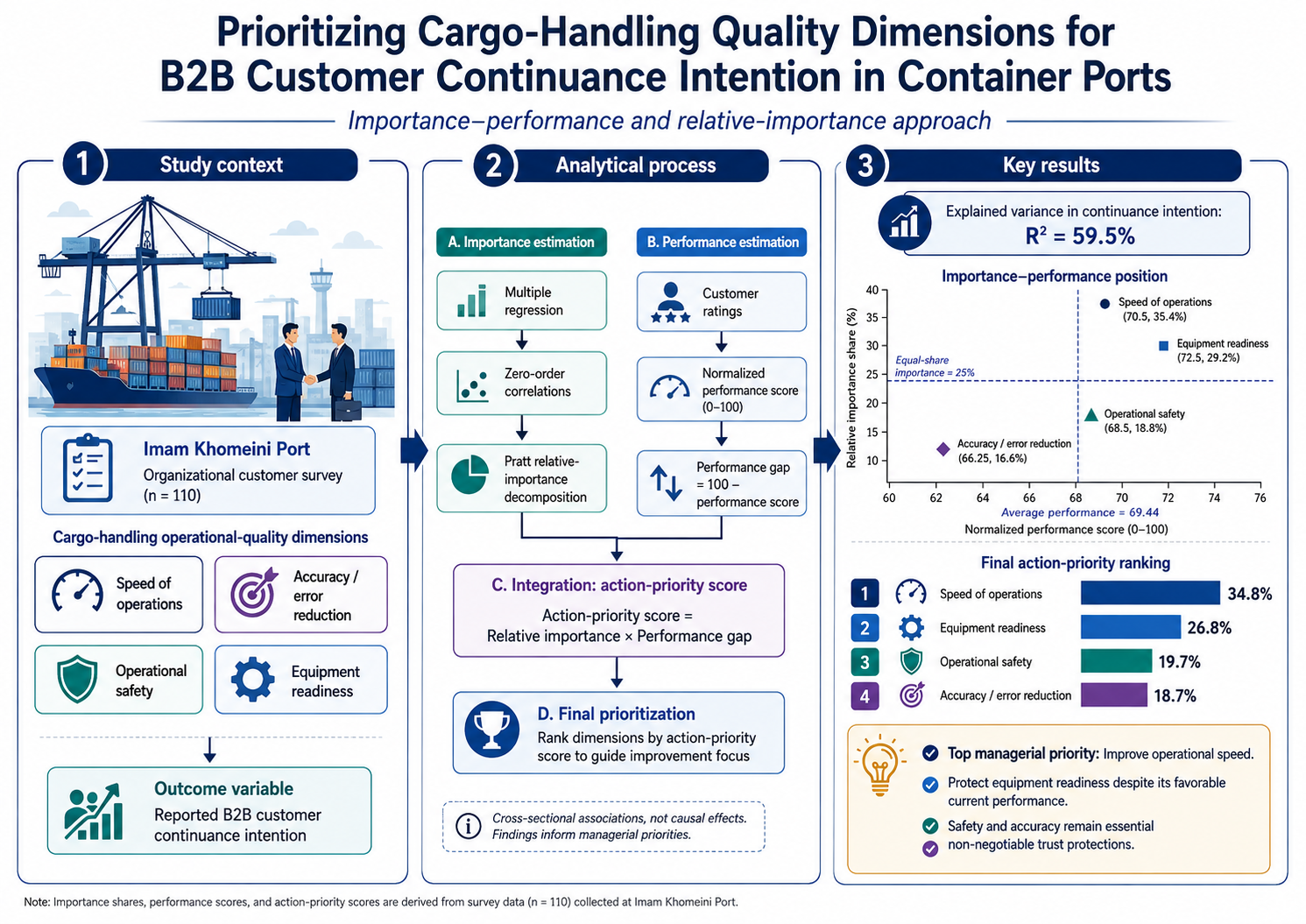
- Cargo-handling quality dimensions jointly explained 59.5% of B2B customer continuance intention.
- Operational speed was the strongest dimension, with the highest relative-importance share (35.4%).
- Equipment readiness ranked second in relative importance (29.2%) and overall action priority.
- The final improvement ranking was speed → equipment readiness → operational safety → accuracy/error reduction.
- The framework showed that the lowest-performing dimension is not necessarily the highest managerial priority.
|
Audio file of the article abstract [MP3] (46 Download)
Abstract
(342 Views) |
Full-Text (PDF)
(70 Downloads)
|
Graphical Abstract
|
Reseach Highlights
Graphical Abstract:
Reseach Highlights:
Highlights
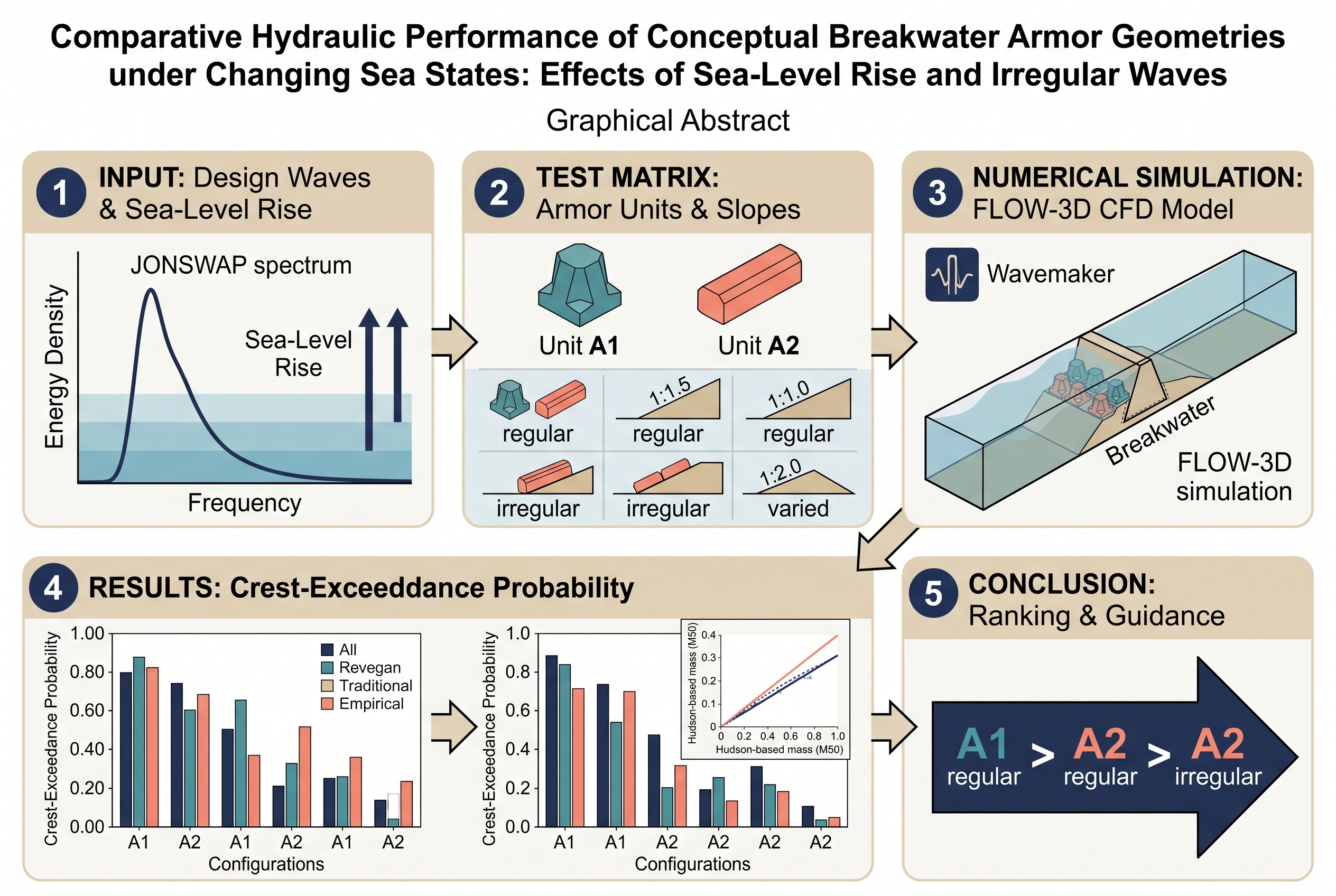
- Six breakwater configurations compared under JONSWAP waves and SLR scenarios.
- Symmetric A1 armor showed lower crest-exceedance than elongated A2 armor.
- At +1.0 m SLR, crest-exceedance rose by 21–57 percentage points.
- Irregular A2 on 1:1.5 slope increased from 35% to 92% exceedance.
- Hudson screening suggests much larger compensatory mass for elongated A2.
|
Audio file of the article abstract [MP3] (27 Download)
Abstract
(120 Views) |
Full-Text (PDF)
(32 Downloads)
|
Graphical Abstract
|
Reseach Highlights
Graphical Abstract:
Reseach Highlights:
Highlights
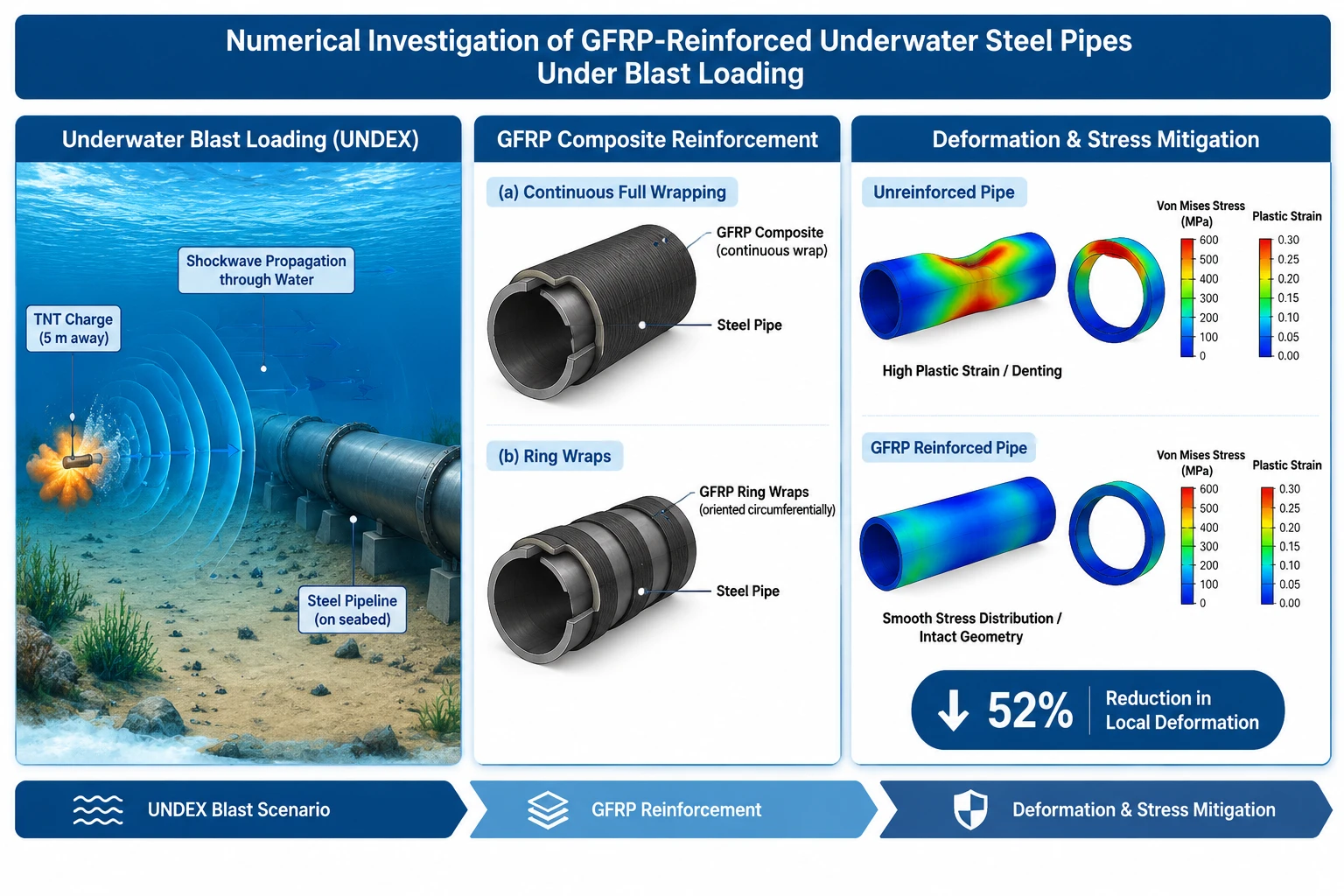
- Numerical modeling of submerged steel pipes under underwater blast (UNDEX) is performed.
- Dynamic structural responses under varying TNT explosion scenarios are investigated.
- Four GFRP retrofitting configurations are evaluated for blast mitigation.
- Continuous GFRP wrapping proves most effective, reducing local deformation by up to 52%.
- Water medium provides significant blast damping compared to in-air explosions.
|
Audio file of the article abstract [MP3] (5 Download)
Export as:
HTML
|
XML
|
RSS

 Parametric Assessment of Hull Geometry Effects on the Coupled Dynamics of Semi-Submersible Floating Wind Turbines